

Making California a Regenerative Economy
Regenerative California partners with counties to create regional regenerative economies — convening, aligning capital and policy, incubating innovative solutions, and co-creating the blueprints for lasting systems change.
Our Mission
Within 10 years, California can demonstrate a different kind of economy is possible — one where strong communities, restored ecosystems, and lasting prosperity grow together.
In this future, regenerative approaches are the norm.
Thriving ecosystems power strong economies
Communities remain whole and rooted to place
Prosperity grows because the living systems around us are healthy
California becomes proof that regeneration is the future of economic leadership.
California is the world’s fourth largest economy; it is a powerhouse of innovation that leads the world in environmental, social and economic progress. If ever there was a place to demonstrate a regenerative economy is possible, it’s right here in California, right now.
Our Vision
Regenerative Economies Replenish and Restore
Regenerative economies rebuild and grow health, prosperity, and resilience for all people and nature. Rather than doing “less bad,” regenerative economies are built within natural boundaries to repair, restore, reinvigorate and regenerate.
Our Operating Model
How regeneration takes root.
We connect communities, capital, and partners to move ideas into action.
Convene + Connect
Work with community to identify regional challenges and opportunities, and a create shared understanding across sectors.
Prove + Scale
Demonstrate economic viability through place-based results that inspire broader adoption.
Map + Elevate
Surface who's already doing the work, building legitimacy and creating momentum for community-led solutions.
Learn + Amplify
Document and share what works through active storytelling and learning networks, to inspire replication across California and beyond.
Support + Enable
Provide resources, tools, and coordination to advance regenerative initiatives and unlock capital.
Community Transition
Equip communities to own, lead, and evolve the work over time.
Key Principles
Our principles of a regenerative economy.
-
Every region is unique. Solutions must grow from the land, waters, culture, and people who call it home.
-
The people closest to the land and the challenges often hold the deepest knowledge of how to care for it. Regeneration begins by listening.
-
Healthy soil, thriving oceans, and biodiversity are not side benefits — they are the foundation of lasting prosperity.
-
A region cannot thrive if the people who grow the food, teach the children, and build the homes cannot afford to live there.
-
Lasting change grows from trust, collaboration, and visible proof that regenerative models work in real places, with real people.
-
Regenerative economies keep resources moving through communities and direct investment toward long-term stewardship of land, ocean, and people.
-
Short-term gains cannot come at the expense of long-term health. Regenerative decisions consider the future we are shaping.
Our Partnership Model
Agents of systems change.
Convenor. Architect. Systems Integrator.
Systems transformation requires actors who have never moved together before. Our role is to be the trusted convenor, architect, and integrator — not to own the work, but to make collective action possible.
Community & Place-Based Partners
Local leaders, fishing families, farmworkers, and neighborhood organizations who hold the trust, knowledge, and lived experience the system needs.
Capital & Financial Partners
Impact investors, CDFIs, philanthropies, and public finance agencies who deploy capital into regenerative models once risk is reduced by demonstrated proof points.
Knowledge & Technical Partners
Research institutions, sector specialists, and peer networks who surface what works, provide technical assistance, and accelerate learning across regions.
Policy & Institutional Partners
Government agencies, regional planners, and advocacy organizations who can shift rules, create enabling conditions, and align public investment with community priorities.
Monterey County.
Our living laboratory.
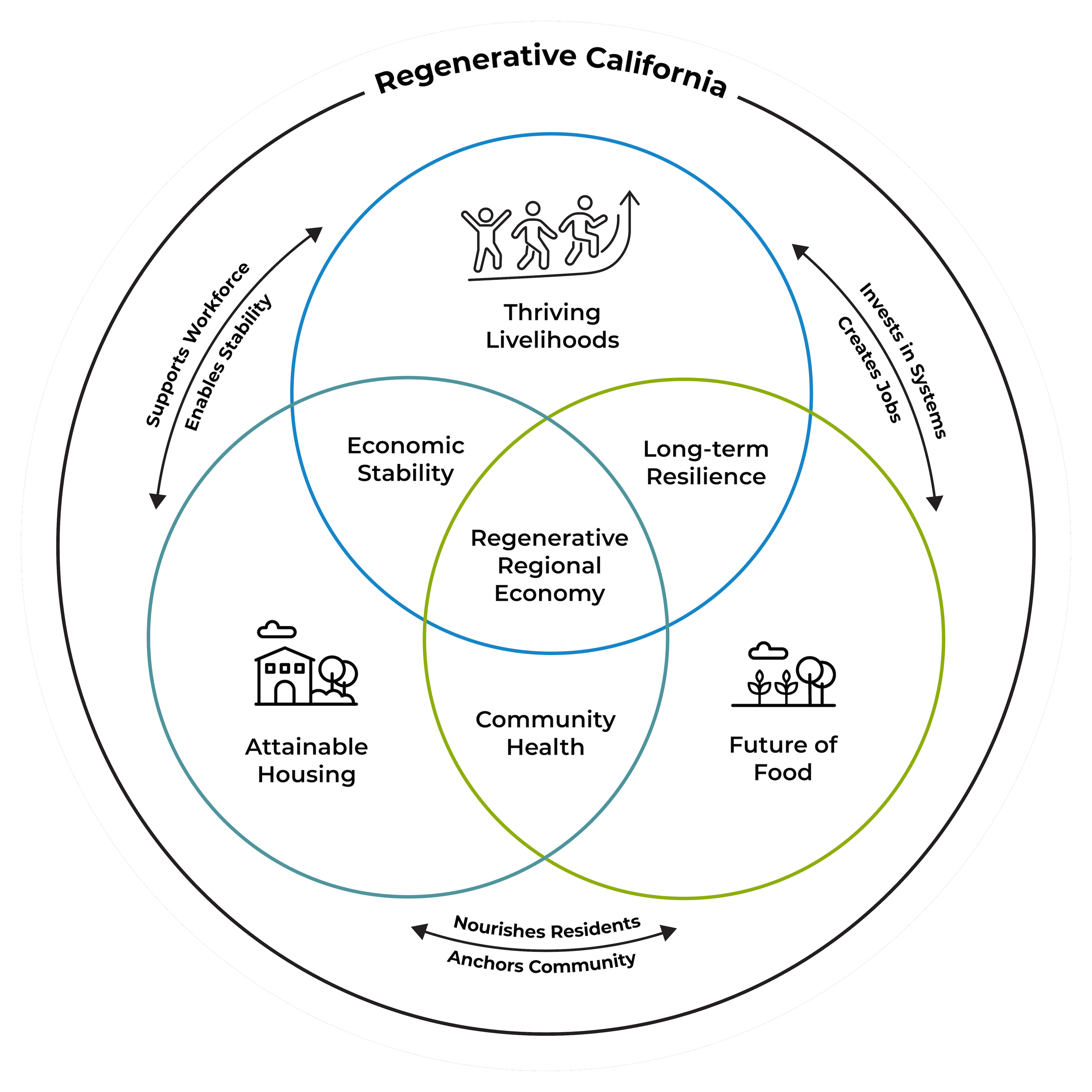
One region, three community-identified initiatives:
Attainable Housing, Future of Food, and Economic Opportunity.
