
If the goal of an economic system is maximizing GDP growth, then its institutions, policies, businesses, and cultural values will organize themselves around that objective. But if success is redefined as human and ecological wellbeing, the entire system begins to behave differently. Post-growth economics is an effort to intervene at one of the deepest system leverage points in the economy.
One of the most influential frameworks within this movement is Doughnut Economics, developed by Kate Raworth. The Doughnut (below) visualizes a "safe and just space for humanity" between two boundaries: a social foundation that ensures everyone's basic needs are met and an ecological ceiling defined by planetary boundaries.
The challenge is not how to maximize growth, but how to meet human needs equitably while remaining within Earth's ecological limits—with thriving people and regenerating ecosystems. The goal is not more, but enough—creating economies that are distributive, regenerative, and capable of supporting wellbeing for present and future generations.
This matters more now than ever: Humans have transgressed at least 7 of the 9 planetary boundaries, bringing biophysical systems to their tipping points, while even “rich” countries are facing gaping social inequalities, suppressed political voice, and shortfalls in other basic human rights. Bringing it all together in a positive vision of a world living within the safe and just space is the appeal of the Doughnut, with practical 🍩solutions rising in many places worldwide.
You can learn more about Doughnut Economics at https://doughnuteconomics.org/, and about how we have been applying it to California at https://caldec.org/.
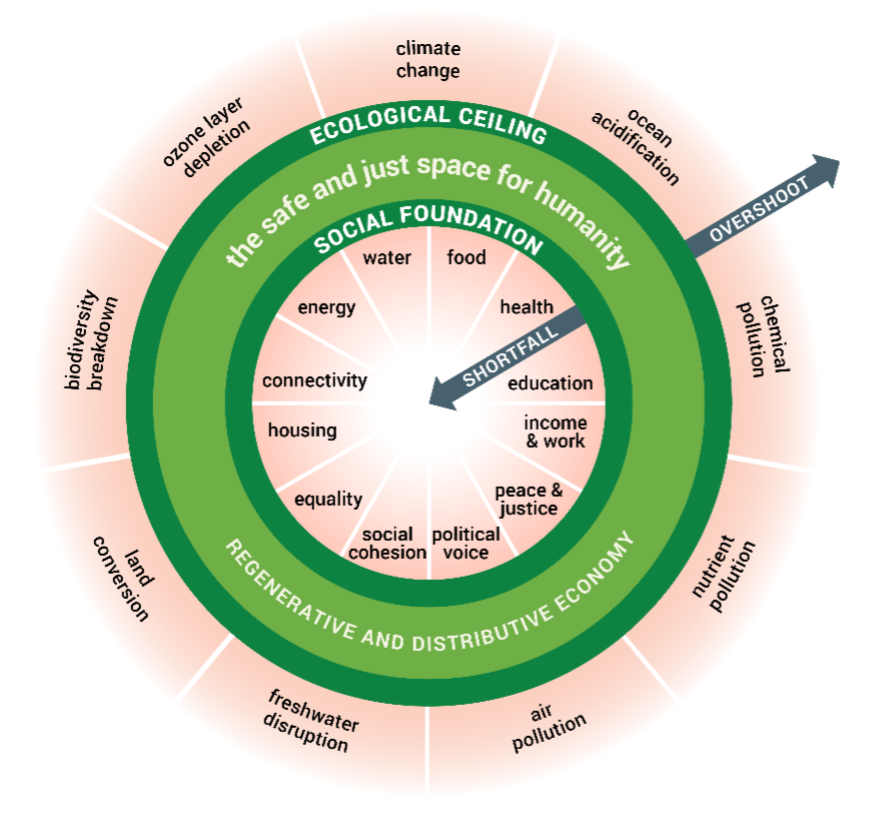
Doughnut Economy
A "safe and just space for humanity" between two boundaries: a social foundation that ensures everyone's basic needs are met and an ecological ceiling defined by planetary boundaries.